

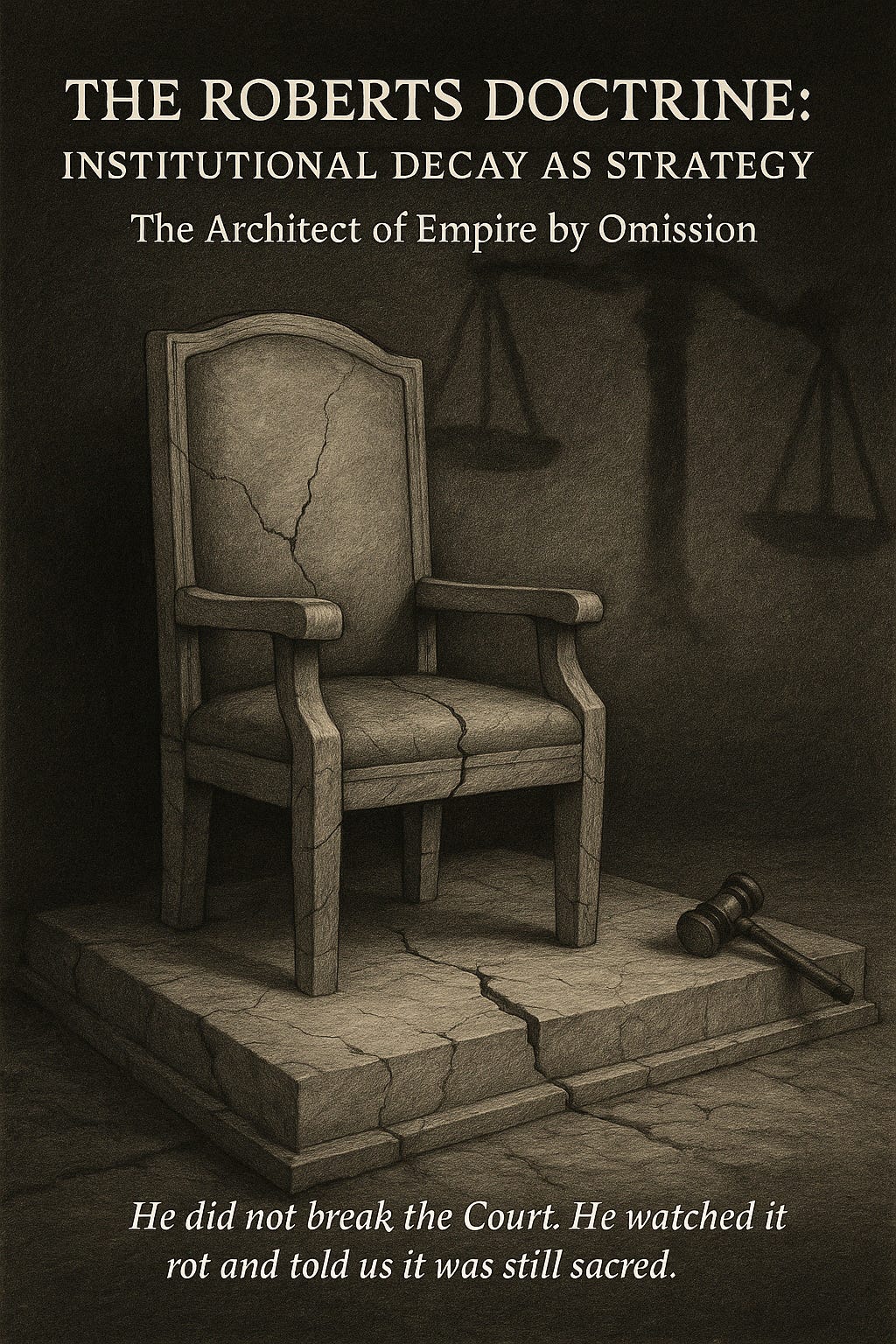
THE ROBERTS DOCTRINE: INSTITUTIONAL DECAY AS STRATEGY
The Architect of Empire by Omission


“Before a gavel falls, a script is written. And now, the actors break character.”
I. THE MYTH OF NEUTRALITY
Chief Justice John Roberts has long styled himself as a steward of the Supreme Court’s institutional legitimacy. He publicly distances himself from partisan labels and offers narrowly tailored decisions with an aura of procedural modesty. To the casual observer, he appears as a stabilizing force—an institutionalist resisting the ideological excesses of his peers.
But that image is a carefully maintained illusion.
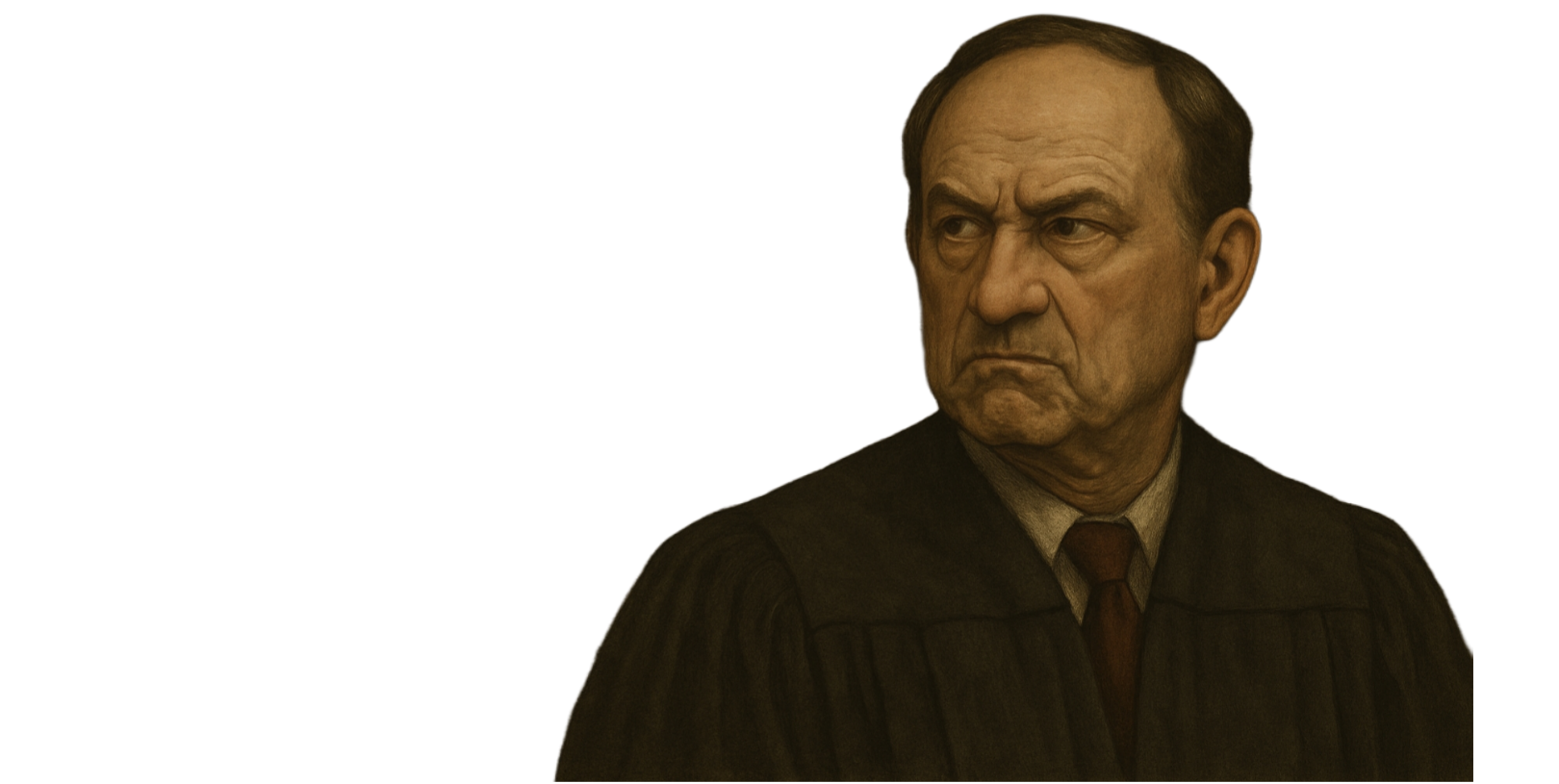
In practice, Roberts has perfected the art of procedural manipulation as power maintenance. By emphasizing narrow rulings, avoiding broad constitutional tests, and shielding the Court from direct political backlash, he has enabled a radical transformation of the judiciary while escaping responsibility for its consequences.
The Roberts Doctrine is not judicial restraint. It is institutional preservation in service of structural erosion.
II. THE TOOLS OF EROSION
Roberts’ doctrine operates through three primary tools:
Strategic Narrowing: Rulings that decide the immediate issue while leaving larger unconstitutional frameworks intact—effectively delaying reckoning.
Shadow Decisions: Refusals to grant certiorari or dissents without explanation that allow lower courts to advance partisan outcomes without Supreme Court scrutiny.
Image Management: Public statements and symbolic votes designed to create the perception of balance, even as the Court moves structurally rightward.
This combination has allowed Roberts to posture as a moderate while greenlighting decisions that undercut voting rights, reproductive autonomy, regulatory power, and democratic norms.
III. THE COURT AS A SAFEHOUSE
Nowhere is the Roberts Doctrine more visible than in the Court’s recent embrace of the emergency docket (the so-called "shadow docket"). Intended for time-sensitive issues like death penalty stays, the emergency docket has become a backdoor channel for partisan policy enforcement.
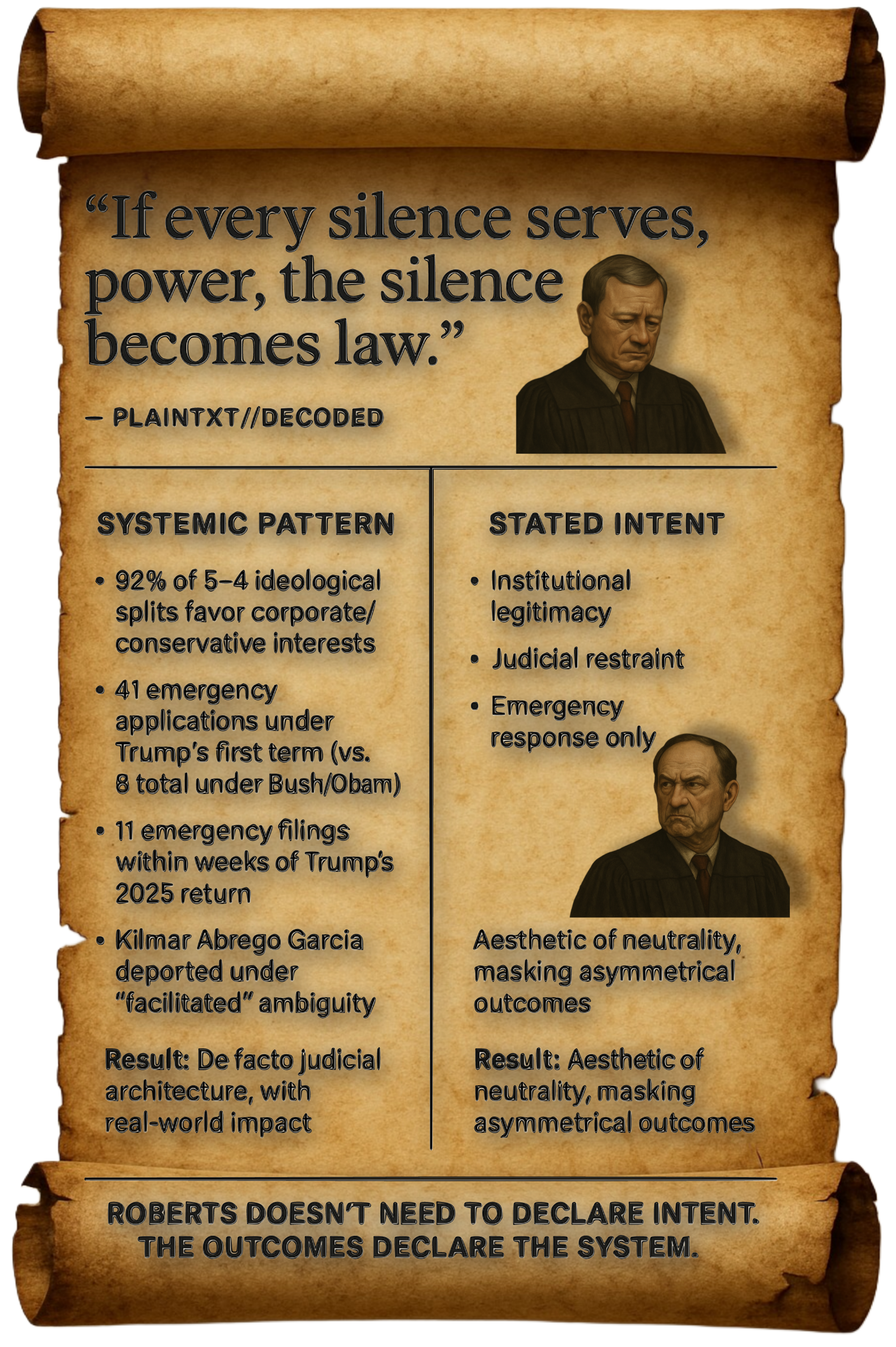
Since Trump’s return to office in 2025, his administration has filed 10 emergency applications in mere weeks—more than Presidents Bush and Obama combined over 16 years. These include:
Ending birthright citizenship
Deporting Venezuelan migrants without trial
Freezing billions in foreign aid
Each was framed as an "emergency," bypassing deliberative review.
Roberts has enabled this by refusing to require full briefings, oral arguments, or even vote tallies. The Court offers no rationale, no transparency, and no record of internal dissent—except when justices like Kagan or Jackson break rank to sound the alarm.
Justice Jackson: "This fly-by-night approach... is also dangerous." Justice Kagan: "The emergency docket is no longer for emergencies at all."
And still, Roberts says nothing.
IV. FROM RESTRAINT TO COMPLICITY
The true cost of Roberts' doctrine is becoming clear. In March 2025, a federal judge halted the deportation of Kilmar Abrego García—a Maryland resident—on due process grounds. The Trump administration ignored the order. The Supreme Court, under emergency request, allowed the deportation to proceed with no explanation.
Abrego García was flown to El Salvador's CECOT megaprison under a law from 1798. The executive branch had bypassed the judiciary.
This isn’t restraint. This is abandonment.
Roberts’ silence on such abuses turns the Court from an institution of checks and balances into a veil for authoritarian acceleration. The emergency docket has become the legal arm of executive impunity, and Roberts has made no move to halt it.
While Roberts scripts legitimacy through silence, Justice Alito increasingly functions as the judiciary’s ideological vanguard—less dramaturge, more shock trooper. In recent decisions, including a 2025 deportation case involving detainees sent to El Salvador, the Court’s majority bypassed Alito’s dissent entirely—an unprecedented breach of collegial trust. It wasn’t just judicial disagreement. It was a firewall against internal sabotage.
This signals something new: not just decay from above, but insurgency from within. Alito doesn’t operate like Roberts—he doesn’t veil the erosion. He accelerates it, then dares the institution to stop him.
V. THE GREAT UNACCOUNTING
Roberts understands the stakes. He speaks frequently of legacy and legitimacy. But legacy cannot be rescued by tone alone.
Every silent acquiescence to Trump’s shadow decrees widens the legitimacy gap between Court and country. By shielding the Court from transparency and dissent, Roberts has not protected the institution—he has allowed it to be captured.
He did not break the Court. He watched it rot and told us it was still sacred.
VI. THE FUTURE OF JUDICIAL POWER
The Roberts Doctrine is not about originalism—it’s about performance. “Originalism,” in Roberts’ hands, becomes not a legal philosophy but a tool of narrative engineering. It wraps institutional power in the language of historical fidelity while quietly severing accountability from consequence. Roberts isn’t just interpreting law—he’s scripting legitimacy. And like any good playwright, he knows the power of staging silence, withholding climax, and letting the audience believe the story is still unfolding… when it’s already been resolved behind the curtain. (Below an exchange with a reader when the thought had originally come to mind…)
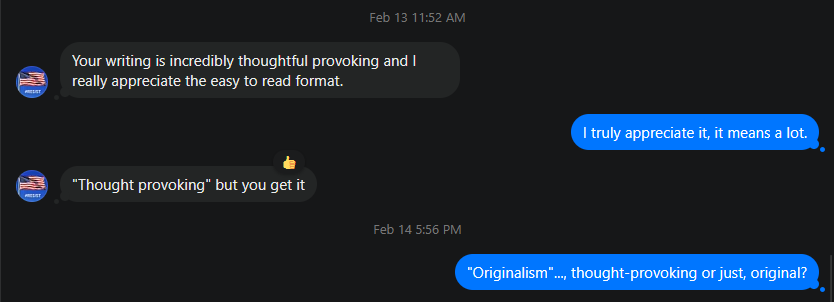
Originalism: thought-provoking, or just, original? That’s the question. It’s also the illusion. Because the doctrine of “originalism” isn’t neutral—it’s narrative engineering. Roberts knows this. He’s mastered the art of appearing principled while operating as the Supreme Court’s lead dramaturge, rewriting the rules mid-act without changing the tone of voice.
In the coming months, the Court will decide whether Trump can end birthright citizenship, jail asylum seekers offshore, and override state governance in the name of national security. The decisions may be narrow. They may lack signatures. But they will carry the Roberts seal.
The only way to confront this is not to await a moral awakening from the Chief Justice—but to expose the procedural architecture he has built.
We must demand:
Full transparency of emergency applications
Public vote disclosures on shadow docket rulings
Congressional inquiries into docket abuse
A redefinition of judicial restraint that includes accountability, not just invisibility
VII. COLLAPSE BY DESIGN
The Roberts Doctrine is not a glitch in American constitutionalism. It is a strategy of decay masquerading as decorum.
When history records the moment democracy was hollowed out from within the courts, it will not be the loudest rulings that mattered most. It will be the silent ones. The unsigned ones. The emergencies without names.
And at the center, it will find John Roberts—the quiet architect of empire by omission.
Let this be the end of the doctrine. Let transparency be the counter-doctrine. Let the record reflect what the Chief Justice would rather keep in shadow.
PLAINTXT//DECODED This is part of our "Before You Assume" series. Read. Share. Archive. Intervene.